← Back to Math 055

7.4 Operational Properties II: Class Notes

7.4a

Derivatives of Transforms

The formulas we saw before ℒ{y′}=sY(s)−y(0) and ℒ{y″}=s2Y(s)−sy(0)−y′(0) are transforms of derivatives. Now we will consider derivatives of transforms.

Consider F(s)=∫0∞e−stf(t)dt. Differentiating with respect to s yields

dds[F(s)]=dds[∫0∞e−stf(t)dt]=∫0∞∂∂s(e−st)f(t)dt=−∫0∞e−sttf(t)dt=−ℒ{tf(t)}

The derivative of e−st with respect to s is −te−st, which brings out the minus sign and the extra factor t.

ℒ{tf(t)}=−dds[F(s)]

Example

Evaluate the given Laplace transform.

ℒ{tsin⁡t}

Solution

The factor t means a negative derivative of the transform of sin⁡t:

ℒ{tsin⁡t}=−dds(1s2+1)=2s(s2+1)2

Answer: ℒ{tsin⁡t}=2s(s2+1)2

ℒ{te−3tsin⁡t}

Solution

Now e−3t is a shift (replace s by s+3 in the transform of sin⁡t), and t is a negative derivative:

ℒ{te−3tsin⁡t}=−dds[1(s+3)2+1]=−dds[(s+3)2+1]−1=2(s+3)[(s+3)2+1]2

Answer: ℒ{te−3tsin⁡t}=2(s+3)[(s+3)2+1]2

Two factors of t. Apply the rule twice:

ℒ{t2f(t)}=ℒ{t·tf(t)}=−dds[ℒ{tf(t)}]=d2ds2[F(s)]

(Each factor of t brings one derivative and one minus sign; the two minus signs cancel.)

In general, we have

Theorem 7.4.1: Derivatives of Transforms

If F(s)=ℒ{f(t)} and n=1,2,3,…, then ℒ{tnf(t)}=(−1)ndndsnF(s).

Example

Use Theorem 7.4.1 to evaluate the given Laplace transform.

ℒ{t2cos⁡t}

Solution

Here n=2 and F(s)=ss2+1. The first derivative (quotient rule) is 1−s2(s2+1)2:

ℒ{t2cos⁡t}=(−1)2d2ds2(ss2+1)=dds(1−s2(s2+1)2)=−2s(s2+1)2+(s2−1)·2(s2+1)·2s(s2+1)4

Cancel one factor of s2+1 from every term, so the denominator becomes (s2+1)3:

=−2s(s2+1)+4s(s2−1)(s2+1)3=2s3−6s(s2+1)3

Answer: ℒ{t2cos⁡t}=2s3−6s(s2+1)3

Example

Use the Laplace transform to solve the given initial-value problem. Use the table of Laplace transforms in Appendix C as needed.

y′−y=tetsin⁡t,y(0)=0

Solution

The right side is the previous kind of transform, with the shift s−1 from et:

sY(s)−Y(s)=−dds[1(s−1)2+1]=2(s−1)[(s−1)2+1]2(s−1)Y(s)=2(s−1)[(s−1)2+1]2Y(s)=2[(s−1)2+1]2

Entry 25 of the table in Appendix C (with k=1) gives ℒ{sin⁡t−tcos⁡t}=2(s2+1)2. Here s is shifted to s−1, so multiply by et:

Answer: y(t)=et(sin⁡t−tcos⁡t)

7.4b

y″+y=f(t),y(0)=1,y′(0)=0,where f(t)={1,0≤t<π/2sin⁡t,t≥π/2

Solution

Write f(t) with unit step functions, as a sum of two pieces:

f(t)={1,0≤t<π/20,t≥π/2+{0,0≤t<π/2sin⁡t,t≥π/2=1−𝒰(t−π/2)+sin⁡t𝒰(t−π/2)

y″+y=1−(1−sin⁡t)𝒰(t−π/2)

The factor 1−sin⁡t is not written in terms of t−π/2, so use the alternative form of the second translation theorem: replace t by t+π/2.

s2Y(s)−s+Y(s)=1s−e−πs/2ℒ{1−sin⁡(t+π/2)}

Aside

sin⁡(t+π/2)=sin⁡tcos⁡π2+cos⁡tsin⁡π2=cos⁡t

(s2+1)Y(s)=s+1s−e−πs/2(1s−ss2+1)

Since s+1s=s2+1s, dividing by s2+1 gives

Y(s)=1s−e−πs/2[1s(s2+1)−s(s2+1)2]

First piece. Partial fractions:

1s(s2+1)=As+Bs+Cs2+1⇒1=A(s2+1)+(Bs+C)s1=As2+A+Bs2+Cs⇒1=(A+B)s2+Cs+A

s2 terms: A+B=0⇒B=−1. s terms: C=0. Constant: A=1. So 1s(s2+1)=1s−ss2+1.

Second piece. Partial fractions As+Bs2+1+Cs+D(s2+1)2 just gives the term back (with C=1 and the other constants 0), so instead use ℒ{tf(t)}=−dds[F(s)], that is, tf(t)=ℒ−1{−dds[F(s)]}. Since

−12∫2s(s2+1)2ds=1/2s2+1,we haves(s2+1)2=−dds(1/2s2+1)

and 1/2s2+1 is the transform of 12sin⁡t, so ℒ−1{s(s2+1)2}=12tsin⁡t.

Y(s)=1s−e−πs/2[1s−ss2+1+dds(1/2s2+1)]

Use the inverse form of the second translation theorem: replace t by t−π/2.

y(t)=1−𝒰(t−π/2)[1−cos⁡(t−π/2)−12(t−π/2)sin⁡(t−π/2)]

Simplify with cos⁡(t−π/2)=sin⁡t and sin⁡(t−π/2)=−cos⁡t:

Answer: y(t)=1−𝒰(t−π/2)[1−sin⁡t+12(t−π/2)cos⁡t]

7.4c

Convolution

Definition

The convolution of f and g is f∗g=∫0tf(τ)g(t−τ)dτ

(τ is the Greek letter tau.) The result is a function of t. It can be shown that f∗g=g∗f.

Tip: Don’t confuse convolution with composition, (f∘g)(x)=f(g(x)), the composition of f with g.

Example

Find cos⁡2t∗et.

Solution

With f(t)=cos⁡2t and g(t)=et, g(t−τ)=et−τ:

cos⁡2t∗et=∫0tcos⁡2τet−τdτ=I

Integrate by parts with u=cos⁡2τ,dv=et−τdτ, so du=−2sin⁡2τdτ,v=−et−τ.

I=−et−τcos⁡2τ|0t+∫0t(−2sin⁡2τ)et−τdτ=−cos⁡2t+et+∫0t(−2sin⁡2τ)et−τdτ

Integrate by parts with u=−2sin⁡2τ,dv=et−τdτ, so du=−4cos⁡2τdτ,v=−et−τ.

I=−cos⁡2t+et+2sin⁡2τet−τ|0t−4∫0tcos⁡2τet−τdτ=−cos⁡2t+et+2sin⁡2t−4I

The last integral is I again. Solve for I:

5I=et−cos⁡2t+2sin⁡2tI=15et−15cos⁡2t+25sin⁡2t

Answer: cos⁡2t∗et=15et−15cos⁡2t+25sin⁡2t

Example

Find ℒ{cos⁡2t∗et}.

Solution

Use the convolution from the previous example:

ℒ{cos⁡2t∗et}=ℒ{15et−15cos⁡2t+25sin⁡2t}=15(1s−1−ss2+4+4s2+4)=15·s2+4+(−s+4)(s−1)(s−1)(s2+4)=15·5s(s−1)(s2+4)=ss2+4·1s−1

Answer: ℒ{cos⁡2t∗et}=s(s2+4)(s−1)

Notice: ℒ{cos⁡2t∗et}=ℒ{cos⁡2t}ℒ{et}.

In general,

Theorem: Convolution Theorem

If f(t) and g(t) are piecewise continuous on [0,∞) and of exponential order, then ℒ{f∗g}=ℒ{f(t)}ℒ{g(t)}=F(s)G(s).

Proof

ℒ{f∗g}=∫0∞e−st∫0tf(τ)g(t−τ)dτdt

Note that 𝒰(t−τ)={0,0≤t<τ1,t≥τ, so 𝒰(t−τ)=0 if τ>t. Multiplying by 𝒰(t−τ) lets the inner integral run to ∞ (the extra part, ∫t∞, is zero):

ℒ{f∗g}=∫0∞e−st[∫0∞f(τ)g(t−τ)𝒰(t−τ)dτ]dt=∫0∞f(τ)[∫0∞e−stg(t−τ)𝒰(t−τ)dt]dτ

After switching the order of integration, the inner integral is ℒ{g(t−τ)𝒰(t−τ)} = e−sτG(s) by the second translation theorem:

=∫0∞f(τ)e−sτG(s)dτ=G(s)∫0∞f(τ)e−sτdτ=G(s)F(s) ✓

Example

Find the Laplace transform of f∗g using the Convolution Theorem. Do not evaluate the convolution integral before transforming.

ℒ{t3∗tsin⁡3t}

Solution

For tsin⁡3t, use −dds[F(s)]:

ℒ{t3∗tsin⁡3t}=ℒ{t3}ℒ{tsin⁡3t}=6s4(−dds(3s2+9))=6s4·6s(s2+9)2=36s3(s2+9)2

Answer: ℒ{t3∗tsin⁡3t}=36s3(s2+9)2

ℒ{∫0tsin⁡τcos⁡(t−τ)dτ}

Solution

The integral is sin⁡t∗cos⁡t (compare with the definition f∗g=∫0tf(τ)g(t−τ)dτ):

ℒ{sin⁡t∗cos⁡t}=ℒ{sin⁡t}ℒ{cos⁡t}=1s2+1·ss2+1=s(s2+1)2

Answer: ℒ{∫0tsin⁡τcos⁡(t−τ)dτ}=s(s2+1)2

7.4d

ℒ{∫0te−τcos⁡τdτ}

Solution

Here f(τ)=e−τcos⁡τ and g(t−τ)=1, so the integral is e−tcos⁡t∗1:

ℒ{e−tcos⁡t∗1}=ℒ{e−tcos⁡t}ℒ{1}=s+1(s+1)2+1·1s=s+1s[(s+1)2+1]

Answer: ℒ{∫0te−τcos⁡τdτ}=s+1s[(s+1)2+1]

The transform of an integral

When g(t)=1, ℒ{g(t)}=G(s)=1/s, the convolution theorem gives

ℒ{∫0tf(τ)dτ}=F(s)s, which in inverse form is ∫0tf(τ)dτ=ℒ−1{F(s)s}.

That is, ∫0tf(τ)dτ=f∗1: dividing a transform F(s) by s integrates f from 0 to t.

Example

Evaluate the given inverse transform.

ℒ−1{1s(s−a)2}

Solution

No partial fractions are needed. Write it as 1s times F(s)=1(s−a)2, and ℒ{teat}=1(s−a)2, so f(τ)=τeaτ:

ℒ−1{1s·1(s−a)2}=∫0tτeaτdτ

Integrate by parts with u=τ, dv=eaτdτ, so du=dτ, v=1aeaτ:

=(τaeaτ−1a2eaτ)|0t=1ateat−1a2eat+1a2

Answer: ℒ−1{1s(s−a)2}=1ateat−1a2eat+1a2

Example

Use the Laplace transform to solve the given integral equation.

f(t)+2∫0tf(τ)cos⁡(t−τ)dτ=4e−t+sin⁡t

Solution

The integral is f∗cos⁡t, so its transform is F(s)·ss2+1:

F(s)+2F(s)ss2+1=4s+1+1s2+1F(s)(1+2ss2+1)=4(s2+1)+(s+1)(s+1)(s2+1)F(s)·s2+2s+1s2+1=4s2+s+5(s+1)(s2+1)F(s)=4s2+s+5(s+1)3

Partial fractions, with a repeated linear factor:

4s2+s+5(s+1)3=As+1+B(s+1)2+C(s+1)3⇒4s2+s+5=A(s+1)2+B(s+1)+C

s=−1: C=4−1+5=8. s2: A=4. s: 2A+B=1, so B=−7.

F(s)=4s+1−7(s+1)2+8(s+1)3=4s+1−7(s+1)2+4·2!(s+1)3

Answer: f(t)=e−t(4−7t+4t2)

Example

Use the Laplace transform to solve the given integrodifferential equation.

dydt+6y(t)+9∫0ty(τ)dτ=1,y(0)=0

Solution

The integral is 1∗y(t), so its transform is 1sY(s):

sY(s)+6Y(s)+9sY(s)=1ss2Y(s)+6sY(s)+9Y(s)=1(s2+6s+9)Y(s)=1 ⇒ Y(s)=1(s+3)2

Answer: y(t)=te−3t

7.4e

Theorem: Transform of a Periodic Function

If f(t) is piecewise continuous on [0,∞), of exponential order, and periodic with period T, then ℒ{f(t)}=11−e−sT∫0Te−stf(t)dt.

Proof

ℒ{f(t)}=∫0Te−stf(t)dt+∫T∞e−stf(t)dt

In the second integral, let t=u+T, so dt=du and u=t−T. The limits change: t=T becomes u=0, and t=∞ stays u=∞. Since f is periodic, f(u+T)=f(u):

∫T∞e−stf(t)dt=∫0∞e−s(u+T)f(u+T)du=e−sT∫0∞e−suf(u)du=e−sTF(s)

Substitute back, and write F(s) as ℒ{f(t)}:

ℒ{f(t)}=∫0Te−stf(t)dt+e−sTℒ{f(t)}ℒ{f(t)}(1−e−sT)=∫0Te−stf(t)dtℒ{f(t)}=11−e−sT∫0Te−stf(t)dt ✓

Example

Find the Laplace transform of the given periodic function.
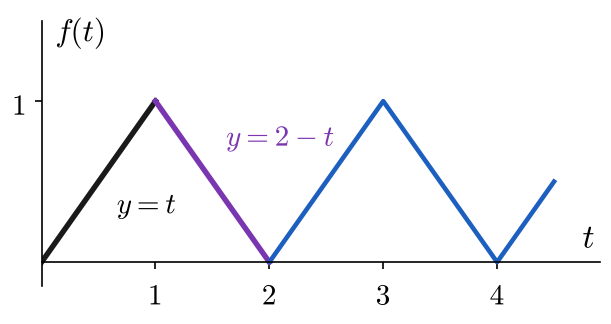
Triangular wave: rises along y = t from 0 to 1, falls along y = 2 minus t to 2, repeats with period 2

Triangular wave f(t) with period T=2. On the first period it rises along y=t from (0,0) to (1,1), then falls along y=2−t to (2,0). The same shape repeats: peaks at t=1,3,… and zeros at t=0,2,4,….

Solution

On one period,

f(t)={t,0≤t<12−t,1≤t<2,f(t+2)=f(t)

so f is periodic with period T=2. By the theorem,

ℒ{f(t)}=11−e−2s∫02e−stf(t)dt=11−e−2s[∫01e−sttdt+∫12e−st(2−t)dt]

Integrate each by parts: u=t, dv=e−stdt for the first, and u=2−t, dv=e−stdt for the second. The two integrals are

∫01e−sttdt=1s2−e−ss−e−ss2,∫12e−st(2−t)dt=e−ss−e−ss2+e−2ss2

Their sum is 1s2(1−2e−s+e−2s). Factor 1−e−2s=(1+e−s)(1−e−s) and cancel:

ℒ{f(t)}=11−e−2s(1−2e−s+e−2s)1s2=1(1+e−s)(1−e−s)(1−e−s)2·1s2

Answer: ℒ{f(t)}=1−e−ss2(1+e−s)