7.3 Operational Properties I: Class Notes
7.3a
Recall
Theorem: First Translation Theorem
If and is any real number, then .
(This is also called a shifting theorem.)
Proof
By Definition 7.1.1,
is playing the role of .
Notation:
We also get an inverse rule:
Example
Find either or , as indicated.
Solution
is what we’re transforming, and shifts to . Since ,
Answer:
Solution
Transform , then shift to :
Answer:
Solution
Complete the square: . The is a shift, and gives and sine (no in the numerator). Multiply and divide by 2:
Answer:
Tip: Recall from partial fractions: an irreducible quadratic factor gets a linear numerator, as in .
Solution
Expand the numerator. The denominator is a repeated linear factor, so the partial fractions are
Compare coefficients and substitute :
Each term is a power of , a shift: use part (b) with , , and . The middle numerator is already , and the last needs , so multiply and divide by 6:
Answer:
7.3b
Example
Use the Laplace transform to solve the initial-value problem.
Solution
Recall
In , and is a shift, so . With :
Partial fractions: , so , giving . The last term needs in the numerator ():
Answer:
Solution
Transform each term (colors match the equation); and :
Multiply the numerator and denominator by , then complete the square:
The shift has to show up in the numerator too: . For sine and cosine, , so ; the sine term needs in its numerator, and :
Answer:
Example
Solve the boundary-value problem.
Solution
The value is not given, so call it . The terms with drop out:
Here (sine) with the shift . Writing for the constant,
Now use :
(At , and .)
Answer:
7.3c
The First Translation Theorem showed how to translate on the -axis. A translation on the -axis is essentially an adjustment for moving the lower limit in the definition of a Laplace transform. This is accomplished via the Heaviside function or unit step function.
Definition
The unit step function is
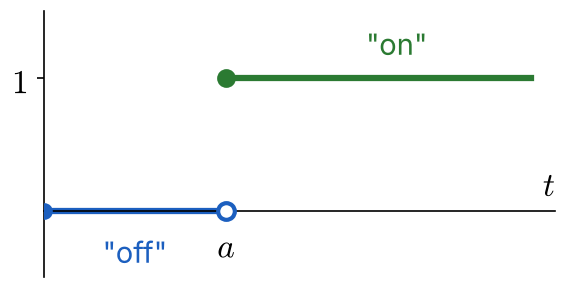
Graph of the unit step function . It is 0 (“off”) for , with an open circle at ; it is 1 (“on”) for , with a filled dot at .
To make it first on and then off:
Consider
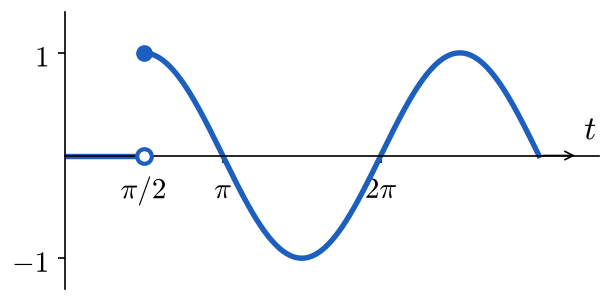
Graph of : 0 for (open circle at ), then the sine curve from onward, crossing 0 at and reaching −1 at . The sine wave is cut off, not shifted.
Shifting the sine yields
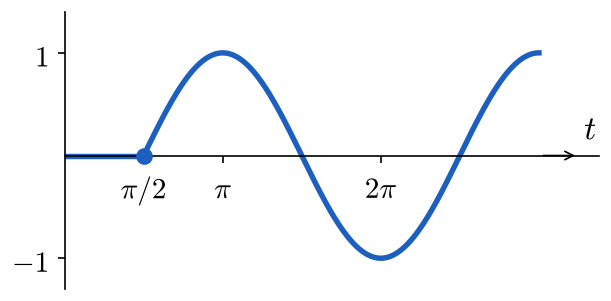
Graph of : 0 for , then a full sine wave that starts at , rises to 1 at , and returns to 0 at . It is the graph of moved units to the right.
Theorem: Second Translation Theorem
If and , then .
Watch the signs: compare with . Here the shift comes with .
Proof
The first integral is 0. In the second, let ; then and . The limits change: becomes , and stays .
This is the shift: the lower limit moved from to .
If we let , then we have .
In inverse form, .
Example
Find either or , as indicated.
Solution
The theorem needs the form , but is not written in terms of : these don’t match. Call and use the alternative form below.
Alternative form of the second translation theorem
Why it works. Start from the original theorem:
Let ; then . So
Back to the example, with and : replace by .
Answer:
7.3d
Inverse form of the Second Translation Theorem
If , then .
You have to make the happen: replace by everywhere in .
Example
Find either or , as indicated.
Solution
Expand the square and split into three inverse transforms. Each uses , shifted by or :
Answer:
Solution
Set the aside for now and find partial fractions for the rest:
Tip: Or use ; it gives the same result.
So , then , and . Bring back and use the inverse form with :
Answer:
Example
Use the Laplace transform to solve the given initial-value problem.
, , where
Solution
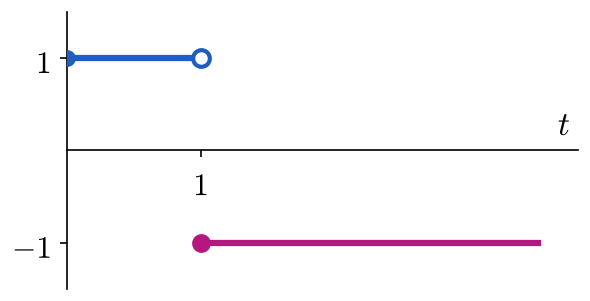
Graph of : a horizontal segment at height 1 for (open circle at ), then a horizontal ray at height −1 for (filled dot at ).
First express using the unit step function. Write it as a sum of two pieces:
Check: ✓
Now solve with :
Partial fractions: , so , giving .
For the last term, use the inverse form with : replace by in .
Answer: