5.1 Linear Models: Initial-Value Problems: Class Notes
5.1a Mass-Spring Models Setup
5.1b
Undamped motion
Example
A mass weighing 32 pounds stretches a spring 2 feet. Determine the amplitude and period of motion if the mass is initially released from a point 1 foot above the equilibrium position with an upward velocity of 2 ft/s. How many complete cycles will the mass have completed at the end of seconds?
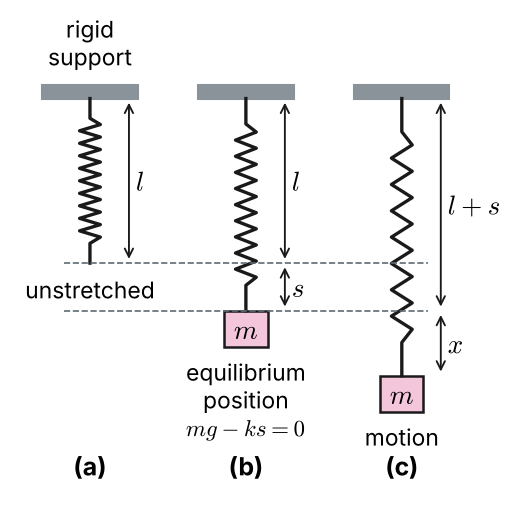
Spring/mass system in three stages (after Figure 5.1.1 in the textbook). (a) An unstretched spring of natural length hangs from a rigid support. (b) A mass is attached and the spring stretches an extra to the equilibrium position, where . (c) In motion, the mass is a distance beyond the equilibrium position, so the spring is stretched beyond its natural length (the equilibrium position sits below the support).
Solution
Setting up the model
Hooke’s Law: . The weight is the force and the stretch is , so
At the equilibrium position (b), the force due to gravity, , balances the restoring force of the spring, :
Assuming down is positive, if the mass is moving, we have (Newton’s 2nd law) with . So
The last two terms are zero by the equilibrium condition, which leaves
where is distance from equilibrium, is the mass, and is the spring constant.
Units
| System | ||||
|---|---|---|---|---|
| Metric | m or cm | N/m | kg | |
| US customary | ft | lb/ft | slugs () |
In the second row, the mass in slugs is the weight in pounds divided by 32.
Solving
The mass weighs 32 lb. Weight is , with :
Dividing by and letting yields
so , where . This gives
For the above example, and , so and
Released from 1 ft above equilibrium (up is negative):
Upward velocity 2 ft/s:
gives . Next, , so
Equation of motion:
Period of motion:
Frequency:
At the end of seconds, the number of cycles is .
Answer:
To find the amplitude
Consider . Factor out :
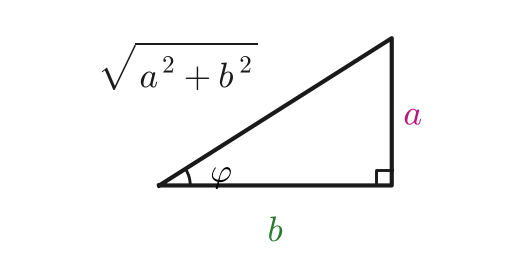
Right triangle with acute angle . Opposite side: . Adjacent side: . Hypotenuse: .
Suppose there is an angle such that and (the triangle above, with opposite and adjacent).
Then we have
So if , then
For our example, , so
But and have the signs of and , both negative, so is in Quadrant III:
Answer:
Generalization
yields
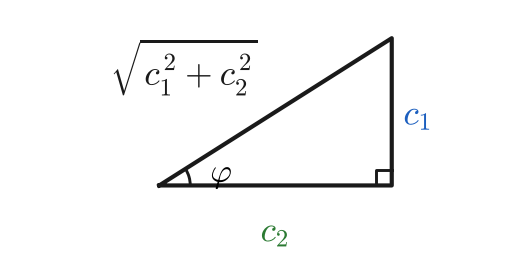
Right triangle with acute angle . Opposite side: . Adjacent side: . Hypotenuse: .
Finding the quadrant
I’ll use and the signs of , to identify the correct quadrant.
gives ( is force: lb, newtons), is mass (kg, slugs), and .
It is also possible to express the solution in terms of cosine:
Justification:
With and , the cosine term matches and the sine term matches , so and , which gives .
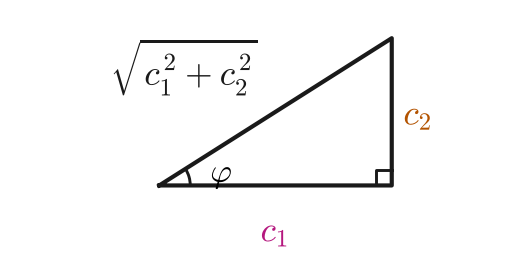
Right triangle with acute angle . Opposite side: . Adjacent side: . Hypotenuse: .
5.1c
Multiple springs in parallel:
Multiple springs in series:
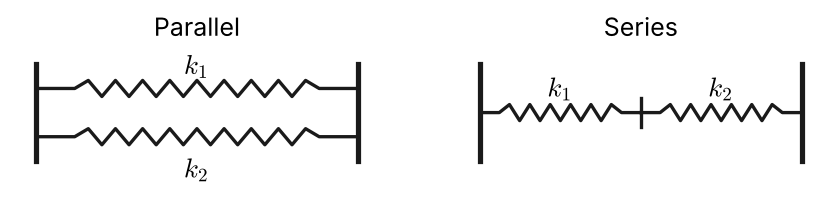
Left (parallel): two springs, with constants and , side by side, each attached to both walls. Right (series): the two springs joined end to end, one after the other, between the walls.
Damped motion
The left side is . On the right, is the restoring force from the spring, and is the damping force; is the damping constant. The damping force is proportional to the instantaneous velocity.
Dividing by :
Let and :
Auxiliary equation:
Case I: (real, distinct roots)
This does not oscillate. This system is overdamped.
Case II:
This is critically damped.
Tip: Critical damping is not going to happen by accident: it needs exactly.
In Case I and Case II, equilibrium is crossed at most 1 time. The motion can look like either sketch below.
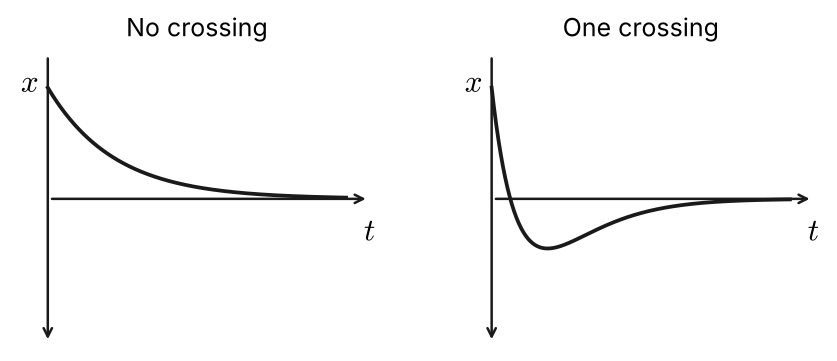
Two sketches of displacement against time (the -axis arrow points down, since down is positive). Left: starts away from equilibrium and decays toward without ever crossing it. Right: starts away from equilibrium, crosses equilibrium once, overshoots a little, and then decays back toward from the other side.
Case III: (complex roots)
This is underdamped. The bracket oscillates with amplitude , and the factor shrinks it, so the motion stays inside the envelope .
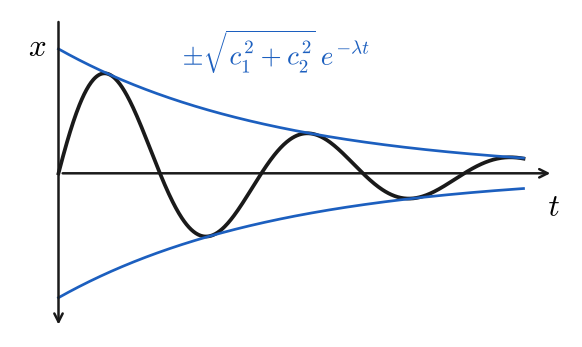
Displacement against time (the -axis arrow points down). The curve oscillates back and forth across equilibrium, and its swings shrink over time. It stays between the two envelope curves (drawn in blue), which decay to .
Driven motion
The forcing term makes the equation nonhomogeneous, so we use undetermined coefficients or variation of parameters.
5.1d
LRC-series circuit
, which is
The first two terms, , alone give an LR-series circuit. The last two, , alone give an RC-series circuit.
“Underdamped,” “critically damped,” and “overdamped” have the same meanings as with spring/mass systems.
The complementary function is the transient term/solution, and the particular solution is the steady-state term/solution.
Example
Find the charge on the capacitor in an LRC-series circuit when h, , f, V, C, and A. Is the charge on the capacitor ever equal to zero?
Solution
Substitute the values ():
Multiply by 4 and factor the auxiliary equation:
Since , the initial conditions give
Divide the second equation by 20 to get , then add it to :
Then .
Answer:
Does ? Set and multiply by :
The only zero is at a negative time.
Answer: