7.1 Orthogonal Matrices: Class Notes
Definition
A square matrix is said to be orthogonal if its transpose is the same as its inverse, that is, if or, equivalently, if . A matrix transformation is said to be an orthogonal transformation or an orthogonal operator if is an orthogonal matrix.
Consider the matrix in Exercise 6.
Multiply by its transpose. Each row of becomes the matching column of , shown in the same color:
A row of times the matching column of (the same row again) gives each 1 on the diagonal, and every other product is 0. So , and is orthogonal.
Theorem 7.1.1
The following are equivalent for an matrix .
a) is orthogonal.
b) The row vectors of form an orthonormal set in with the Euclidean inner product.
c) The column vectors of form an orthonormal set in with the Euclidean inner product.
Tip: The rows (or columns) must be orthonormal, not just orthogonal.
Theorem 7.1.2
a) The transpose of an orthogonal matrix is orthogonal.
b) The inverse of an orthogonal matrix is orthogonal.
c) A product of orthogonal matrices is orthogonal.
d) If is orthogonal, then or .
Proof of (d)
orthogonal , so
Since ,
#8
Let be multiplication by the orthogonal matrix in Exercise 6. Find for the vector , and confirm relative to the Euclidean inner product on .
Solution
So matches . This is always the case if is orthogonal.
Answer:
Theorem 7.1.3
If is an matrix, then the following are equivalent.
a) is orthogonal.
b) for all in [length is preserved].
c) for all and in [the dot product is preserved].
Proof of (a) ⇒ (b)
orthogonal , so
Example 4: Rotations in the xy-plane
Sometimes a problem is more easily approached in by considering a set of rotated axes, . Then a fixed point has coordinates relative to the rotated axes.
We start with , (in particular, , ), unit vectors along the - and -axes, and consider , along the - and -axes. We'll treat the rotation as a change from an old basis to .
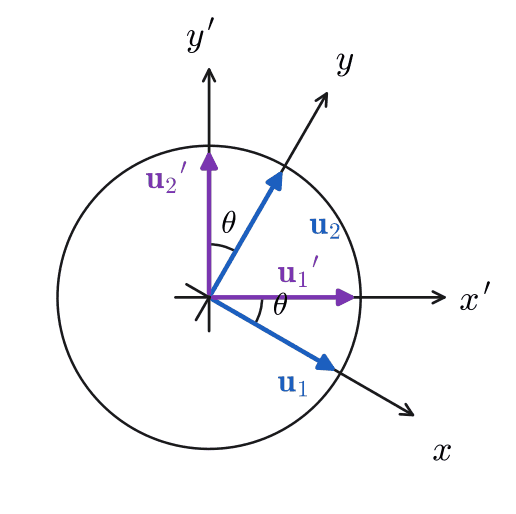
Unit circle with the - and -axes drawn horizontal and vertical. The - and -axes sit at angle clockwise from them, since the -axes are the -axes rotated counterclockwise through . Unit vectors and point along the - and -axes, and and point along the - and -axes.
From 4.7,
Relative to and ,
so
So
These are the rotation equations for .
For (rotating about the -axis):
This differs from the operator in 1.8 because rotates a vector to a new location. Here, the point is fixed; the axes are rotated.
Note that the rotation matrices are orthogonal matrices:
#14
Consider the rectangular -coordinate system obtained by rotating a rectangular -coordinate system counterclockwise through the angle .
a. Find the -coordinates of the point whose -coordinates are .
b. Find the -coordinates of the point whose -coordinates are .
Solution
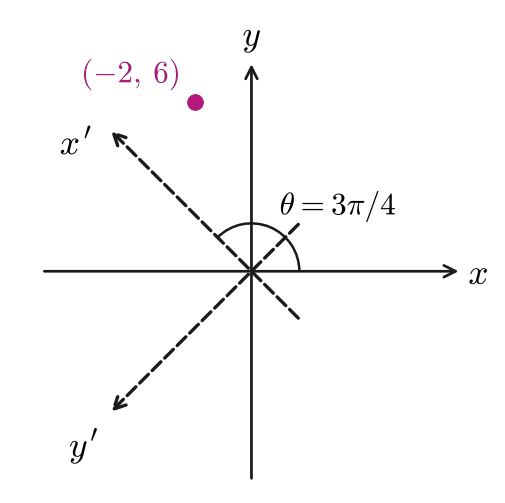
The -axes with the -axis (dashed) at angle counterclockwise from the positive -axis, pointing up and to the left, and the -axis (dashed) pointing down and to the left. The point is in quadrant II of the -system.
With , and .
a.
Answer:
b. Solve for and with the inverse. The rotation matrix is orthogonal, so its inverse is its transpose: its first column becomes the first row and its second column becomes the second row.
Answer:
Theorem 7.1.5
Let be a finite-dimensional inner product space. If is the transition matrix from one orthonormal basis for to another orthonormal basis for , then is an orthogonal matrix.
Theorem 7.1.4
If is an orthonormal basis for an -dimensional inner product space , and if and then:
a)
c)
#23
The set is an orthonormal basis for with respect to the evaluation inner product at the points , , . Let and .
a. Find and .
b. Use Theorem 7.1.4 to compute , , and .
Solution
Call the basis vectors, in order, , , .
Part of (a) Since is orthonormal,
Answer:
Part of (b)
Answer: