3.1 Vectors in 2-Space, 3-Space, and n-Space: Class Notes
Definition
If is a positive integer, then an ordered -tuple is a sequence of real numbers . The set of all ordered -tuples is called real -space, denoted by .
If a vector in 2-space or 3-space is positioned with its initial point at the origin of a rectangular coordinate system, then the coordinates of its terminal point are components of relative to the coordinate system. The numbers in an -tuple can be considered coordinates of a point or components of a vector.
#5
a. Find the terminal point of the vector that is equivalent to and whose initial point is .
b. Find the initial point of the vector that is equivalent to and whose terminal point is .
Solution
a. Equivalent vectors have the same length and direction. Start at and move by the components of :
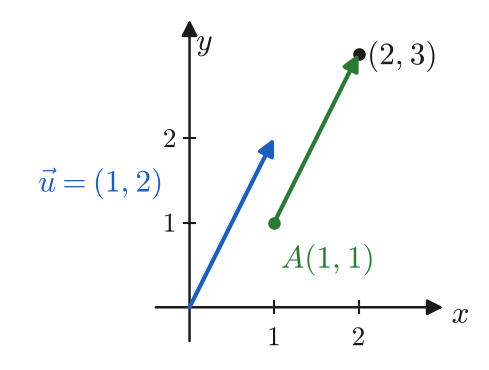
Coordinate axes. The vector is drawn from the origin. An equivalent copy starts at and ends at ; the two arrows are parallel and the same length.
Check: the copy of has components (terminal minus initial) .
Answer:
b. (Formal approach) Let be the initial point of . Terminal minus initial gives the components:
so , , and . Then , , .
Answer:
#7
Find the initial point of a nonzero vector with terminal point and such that
a. has the same direction as .
b. is oppositely directed to .
Solution
a. Let . Then . Take :
Answer:
Tip: Any positive multiple of has the same direction, so other answers are possible; choosing gives the simplest one.
b. oppositely directed to means . Then, the same as part (a):
Answer:
Definition
If and are vectors in , and if is any scalar, then we define
- [this is vector addition]
- [this is scalar multiplication]
#12
Let , , and . Find the components of
a.
b.
c.
d.
Solution
a. Add matching components of and :
Answer:
b.
Answer:
c.
Answer:
Geometrical vector addition
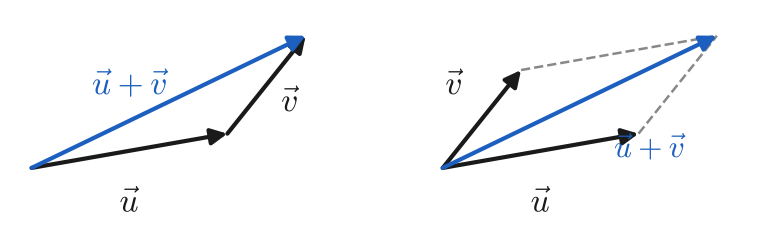
Left: is placed with its initial point at the tip of ; goes from the tail of to the tip of . Right: and share an initial point and form two sides of a parallelogram (other sides dashed); is the diagonal from the shared initial point.
Scalar multiplication
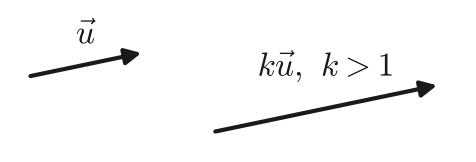
For , points the same direction as and is times as long.
Subtraction
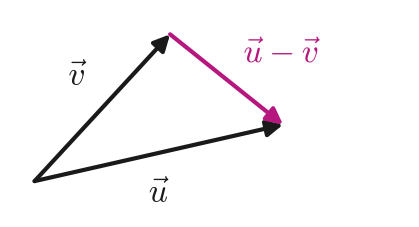
and share an initial point. goes from the tip of to the tip of , since .
The zero vector, , has length zero.
Written by hand, the zero vector is .
Theorem 3.1.1
If , , and are vectors in , and if and are scalars, then:
a)
b)
c)
d)
e)
f)
g)
h)
Proof of (f)
This proof uses the components of the vectors. Let and .
Tip: When we use properties of real numbers, we need to use them on real numbers: here the distributive property is applied to the components , which are real numbers.
Theorem 3.1.2
If is a vector in and is a scalar, then:
a)
b)
c)
Definition
If is a vector in , then is said to be a linear combination of the vectors in if it can be expressed in the form , where each is a scalar. The scalars are called the coefficients of the linear combination. In the case where , we have , in which case the linear combination is a scalar multiple of the vector.
#17
Let and . Find scalars and so that .
Solution
Call the right side and write the vectors as columns:
This system has augmented matrix with columns , , and . Row reduce:
Answer:
Check:
Tip: This is overkill, but it lets us practice a matrix approach.