2.1 Determinants by Cofactor Expansion: Class Notes
Recall
The number is the determinant of the matrix . This section defines the determinant for larger square matrices.
Definition
If is a square matrix, then the minor of entry aij is denoted by and is defined to be the determinant of the submatrix that remains after the th row and th column are deleted from . The number is denoted by and is called the cofactor of entry aij.
In short, for a matrix :
Example
Find all the minors and cofactors of .
Solution
Notation: square brackets mean a matrix, as in . Vertical bars mean a determinant (a number):
The sign depends only on the position: , , and so on, giving the pattern
So in a + position, the cofactor equals the minor, and in a − position, the cofactor is the negative of the minor.
Minors and cofactors. Each minor is a determinant. For example, deleting row 1 and column 1:
The rest are found the same way.
Definition
If is an matrix, then the number obtained by multiplying the entries in any row or column of by the corresponding cofactors and adding the resulting products is called the determinant of A, and the sums themselves are called cofactor expansions of A. That is,
Example
Compute the determinant of the matrix above.
Solution
Tip: Use the right symbol: the matrix is , and its determinant is . Writing brackets for a determinant (or bars for a matrix) is incorrect.
Expand along the first row, using the cofactors found above:
Answer:
#11
Use the arrow technique of Figure 2.1.1 to evaluate the determinant.
Solution
Copy the first two columns to the right of the determinant. Multiply along the three down-right diagonals and add those products; multiply along the three up-right diagonals and subtract those products.
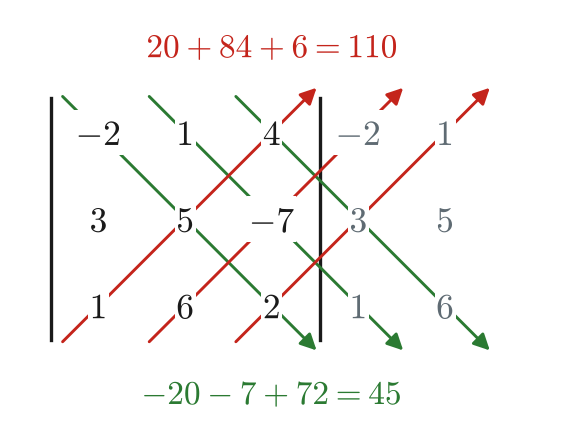
The rows ; ; (the last two columns repeat the first two). Down-right diagonals: , , . Up-right diagonals: , , .
Answer:
Arrow method for 2 × 2 determinants
Multiply along the down-right diagonal and subtract the product along the up-right diagonal.
Tip: The arrow technique works only for and determinants; it does not work for or larger.
Theorem 2.1.1
If is an matrix, then regardless of which row or column of is chosen, the number obtained by multiplying the entries in that row or column by the corresponding cofactors and adding the resulting products is always the same.
#16
Find all values of for which .
Solution
Expand across row 1: its last two entries are 0, so only the first term remains.
Answer:
Theorem 2.1.2
If is an triangular matrix (upper triangular, lower triangular, or diagonal), then is the product of the entries on the main diagonal of the matrix; that is, .
#31
Evaluate the determinant of the given matrix by inspection.
Solution
The matrix is upper triangular, so by Theorem 2.1.2 its determinant is the product of the diagonal entries:
Answer:
Why this works. Expand along the first column again and again; each time, only the top entry is nonzero:
Tip: There is no need to write all this out each time; it just shows why Theorem 2.1.2 is true.
Aside
Let and .
is not defined (the sizes don’t match), but
is defined, since each determinant is just a number.