1.8 Introduction to Linear Transformations: Class Notes
Definitions
is the set of all ordered pairs, is the set of all ordered triples, and is the set of all ordered -tuples. Elements of are called vectors.
The standard basis vectors for are , , …, . These can also be written as row vectors if convenient.
is the -plane, and is 3-space.
All vectors in can be expressed as linear combinations of these vectors:
Definitions
A function is a rule that associates with an input (an element of the domain of ) a unique output (an element of the codomain of ). The output is the image of the input, and the set of all images is called the range of . Note that the range of is a subset of the codomain of .
: is the image of under , where domain of and codomain of .
Consider . Domain: . Codomain: . Range: . The range is a subset of the codomain.
Transformations
Consider the system
In matrix form, this is
The matrix maps vectors in into vectors in . is called a matrix transformation from to .
Definition
If is a function with domain and codomain , then we say that is a transformation from to or that maps from to , which we denote by writing . In the special case where , a transformation is sometimes called an operator on .
#5
Find the domain and codomain of the transformation defined by the matrix product.
a. b.
Solution
a. A matrix times a vector gives a vector.
Answer:
Answer:
Definitions
A matrix transformation maps a vector to a vector by multiplying on the left by [which is an matrix]. If , then we call the transformation a matrix operator. A matrix transformation is denoted or if we do not need to specify the domain and codomain. This can also be written in the form
verbalized as “ maps into .” The matrix is the standard matrix for the transformation.
#8
Find the domain and codomain of the transformation defined by the formula.
a.
b.
Solution
For example, in a, and in b.
Answer:
Answer:
#12
Find the standard matrix for the transformation defined by the equations.
a.
b.
Solution
a. In matrix form, .
Answer:
b.
Answer:
#13
Find the standard matrix for the transformation defined by the formula.
a.
b.
Solution
a. As a column, . The coefficients of the first component form row 1, and the coefficients of the second component form row 2.
Answer:
b.
Answer:
Two special transformations:
Definitions
The zero transformation from to , , maps every vector in to the zero vector in . The identity operator maps every vector in to itself.
Theorem 1.8.1 Properties of Matrix Transformations
For every matrix the matrix transformation has the following properties for all vectors and and for every scalar :
- (homogeneity property)
- (additivity property)
Here . These properties follow from properties of matrix arithmetic.
Tip: Compare with functions of real numbers: has the additivity property, but .
Theorem 1.8.2
is a matrix transformation if and only if the following relationships hold for all vectors and and for every scalar :
- (additivity property)
- (homogeneity property)
Proof
From properties of matrix arithmetic: Theorem 1.8.1 (b) and (c).
Assume (i) and (ii) hold. The proof will be complete if there is an matrix such that for all . By (i) and (ii),
for all vectors and all scalars . Let
where is a standard basis vector for . Then, for ,
a linear combination of the column vectors of in which the coefficients are the entries of (Theorem 1.3.1). We then have
by linearity of .
Definitions
The properties (i) and (ii) in the preceding theorem are called linearity conditions. A transformation that possesses these properties is a linear transformation.
Theorem 1.8.3
Every linear transformation from to is a matrix transformation, and conversely every matrix transformation from to is a linear transformation.
This is vocabulary: for transformations from to , “linear transformation” and “matrix transformation” mean the same thing.
Theorem 1.8.4
If and are matrix transformations, and if for every vector in , then .
#22
Use Theorem 1.8.2 to show that is a matrix transformation.
a.
b.
Solution
We need to show that (i) and (ii) .
a. Here . Let , , and . Then . The three components of play the roles of , , and :
These are equal, so .
Answer:
#23
Use Theorem 1.8.2 to show that is not a matrix transformation.
a.
b.
Solution
a. Homogeneity fails:
Or, with numbers: let , , . Then
Answer:
Tip: The part of the proof of Theorem 1.8.2 suggests a technique for finding the standard matrix for a transformation: find what it does to the standard basis vectors. These images are the columns.
#28
The images of the standard basis vectors for are given for a linear transformation . Find the standard matrix for the transformation, and find .
, , ;
Solution
The images of the standard basis vectors are the columns of the standard matrix :
Answer:
Answer:
Recall
#5 Find the domain and codomain of the transformation defined by the matrix product. a.
Each image of a standard basis vector is a column of :
Example
Find the standard matrix for the linear transformation for which
and use it to compute .
Solution
Thought process: let and . If we can find , such that , then we can form . Likewise for .
We then want , such that (or ):
Solve both systems simultaneously, with and as two right-hand-side columns:
:
:
The third column gives the and that give ; the fourth column gives the and that give .
Answer:
Answer:
Matrix operators on
Reflection operators
- Reflection about the -axis: ,
- Reflection about the -axis: ,
- Reflection about the line : ,
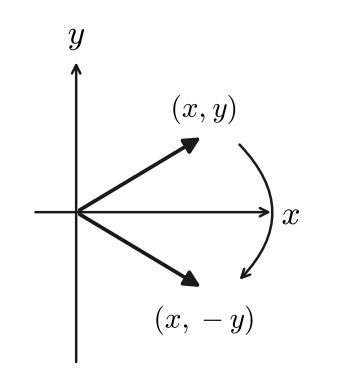
A vector above the -axis and its reflection , the same distance below the -axis.
Projection operators
- Orthogonal projection onto the -axis: ,
- Orthogonal projection onto the -axis: ,
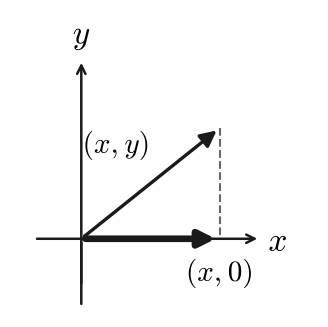
A vector and its orthogonal projection (drawn thicker) on the -axis, directly below its tip.
Rotation operator
- Counterclockwise rotation about the origin through an angle :
The first column is and the second column is .
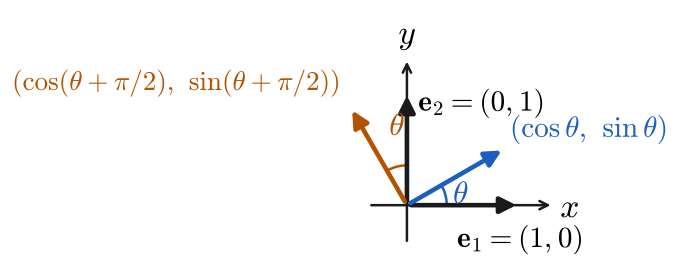
The standard basis vectors and are each rotated counterclockwise through the angle . The image of is . The image of makes the angle with the positive -axis, so it is .
Similarly, , so .
Matrix operators on
Reflection operators
- Reflection about the -plane: ,
- Reflection about the -plane: ,
- Reflection about the -plane: ,
Projection operators
- Orthogonal projection onto the -plane: ,
- Orthogonal projection onto the -plane: ,
- Orthogonal projection onto the -plane: ,