1.10 Applications of Linear Systems: Class Notes
Definitions
A network is a set of branches through which something flows. Branches meet at nodes or junctions. Networks in our work will feature flow conservation, meaning the rate of flow in and out are equal at each node.
#1
The accompanying figure shows a network in which the flow rate and direction of flow in certain branches are known. Find the flow rates and directions of flow in the remaining branches.
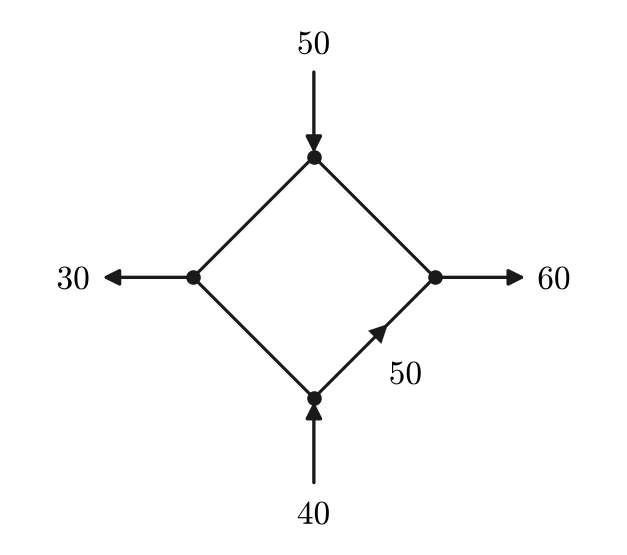
A diamond-shaped network with a node at the top, left, right, and bottom. A flow of 50 enters the top node from above. A flow of 30 leaves the left node to the left. A flow of 60 leaves the right node to the right. A flow of 40 enters the bottom node from below. On the branch from the bottom node to the right node, a flow of 50 moves toward the right node. The other three branches (bottom to left, left to top, top to right) have unknown flows.
Solution
Pick a direction for the flow in each unknown branch. Label the nodes (left), (top), (right), and (bottom), and let be the flow from to , the flow from to , and the flow from to .
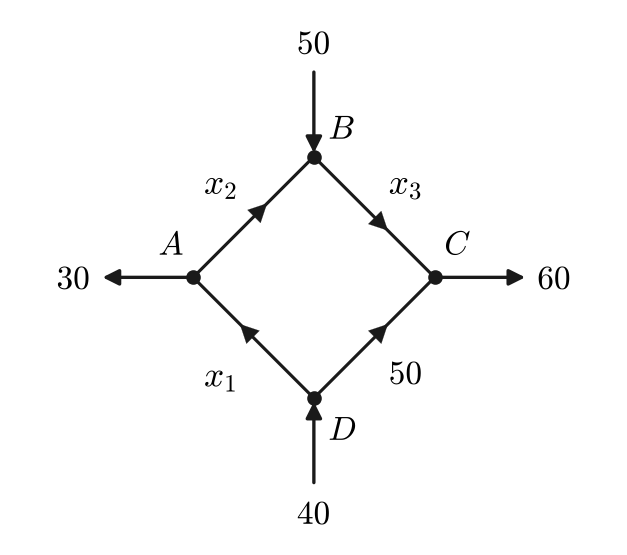
The same network with nodes labeled (left), (top), (right), (bottom). flows from to , from to , and from to .
At each node, rate in = rate out:
Moving the variables to one side:
Solving: use an appropriate method. (Ideally, practice the methods from this course, but honestly, in this case it’s overkill.)
The value also agrees with the equation at node .
A negative flow means the flow goes the opposite way from the direction we picked. So is a flow of 10 from to , and is a flow of 40 from to .
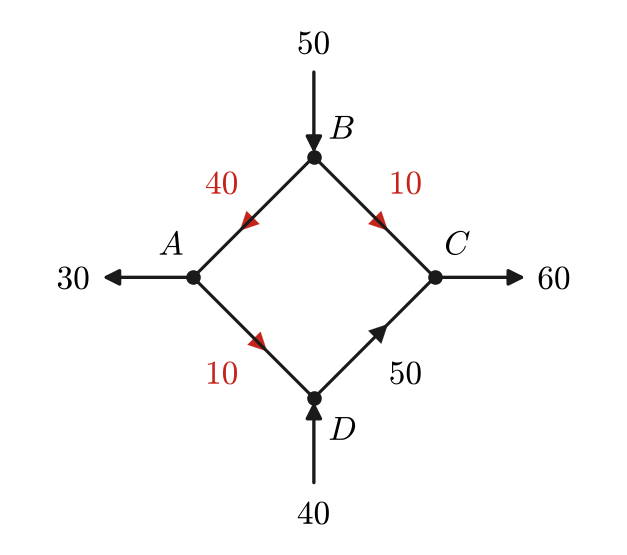
The solved network: 40 flows from to , 10 flows from to , and 10 flows from to .
Answer: 40 from to , 10 from to , and 10 from to .
Tip: Check flow conservation at node : 40 flows in, and 30 + 10 = 40 flows out.
Definitions
A battery is a source of electric energy, and a resistor dissipates electric energy. A node is where three or more wires join in a circuit. A closed loop begins and ends at the same node.
Ohm’s Law
, where (volts) is voltage drop at a resistor with resistance (ohms) in a circuit with current (amperes).
Kirchhoff’s Laws (summary)
Net current (in and out) at a node is zero, and net voltage change (rises and drops) in a closed loop is zero.
#6
Analyze the given electrical circuit by finding the unknown currents.
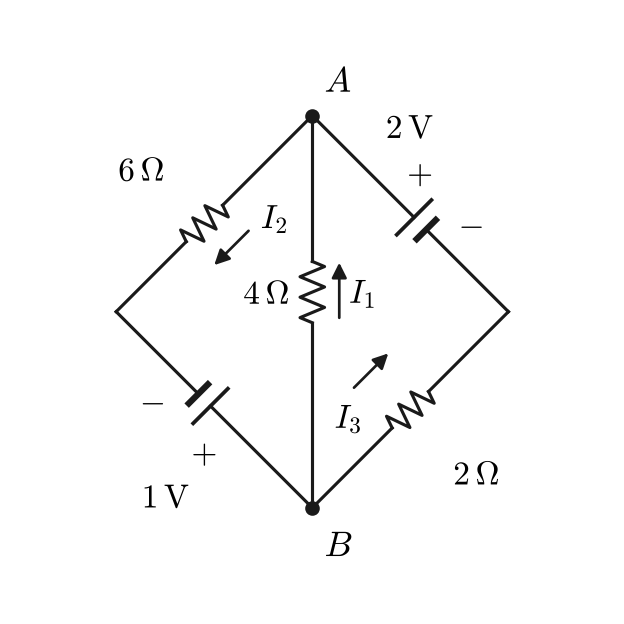
A diamond-shaped circuit with node at the top and node at the bottom, joined by a middle wire with a resistor and current pointing up, toward . Left side: from , a resistor with current pointing away from , then a 1 V battery whose negative terminal is on the upper side and positive terminal on the lower side, down to . Right side: from , a 2 V battery whose positive terminal is on the upper side and negative terminal on the lower side, then a resistor with current pointing up, from toward .
Solution
This circuit contains 3 closed loops: the left loop, the right loop, and the outer loop. We go around each one clockwise.
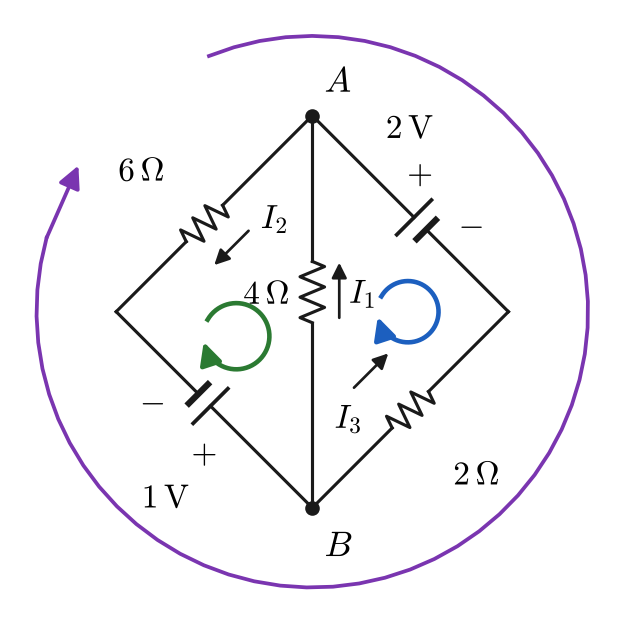
The same circuit with node at the top and at the bottom, and three clockwise loops marked: the left loop (through the resistor, the 1 V battery, and the resistor), the right loop (through the 2 V battery, the resistor, and the resistor), and the outer loop (around the outside, skipping the middle wire).
Nodes. Count current into a node as positive and current out of a node as negative:
These are equivalent equations (each is the other times ), so we only use one of them.
Clockwise right loop. Starting at : going through the 2 V battery from + to − is a drop of 2. Going through the resistor against is a rise of . Going up through the resistor with is a drop of .
Clockwise left loop. Starting at : going through the 1 V battery from + to − is a drop of 1. Going through the resistor against is a rise of . Going down through the resistor against is a rise of .
Outer loop. . This equation is redundant: it is the sum of the left-loop and right-loop equations, so we don’t need it.
System:
In matrix form:
Row reduce the augmented matrix:
and , then :
:
The entries below the diagonal are now zero. Next clear the third column: and :
:
Divide each row by its pivot:
Answer:
Tip: Since is negative, the arrow given for points in the wrong direction: a current of A flows down through the resistor.
Tip: Check with the outer loop: .
Theorem 1.10.1 Polynomial Interpolation
Given any points in the -plane that have distinct -coordinates, there is a unique polynomial of degree or less whose graph passes through those points.
#16
The accompanying figure shows the graph of a cubic polynomial. Find the polynomial.
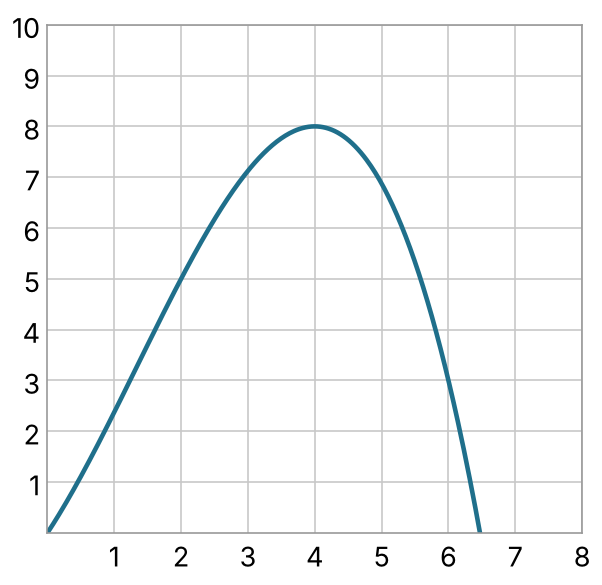
Graph on a grid with from 0 to 8 and from 0 to 10. The curve starts at , passes through , reaches a peak at , passes through , and crosses the -axis just before .
Solution
The polynomial is a cubic, so it has the form of a general cubic polynomial:
A cubic has 4 coefficients, so we need 4 points (Theorem 1.10.1 with ). Read them off the grid:
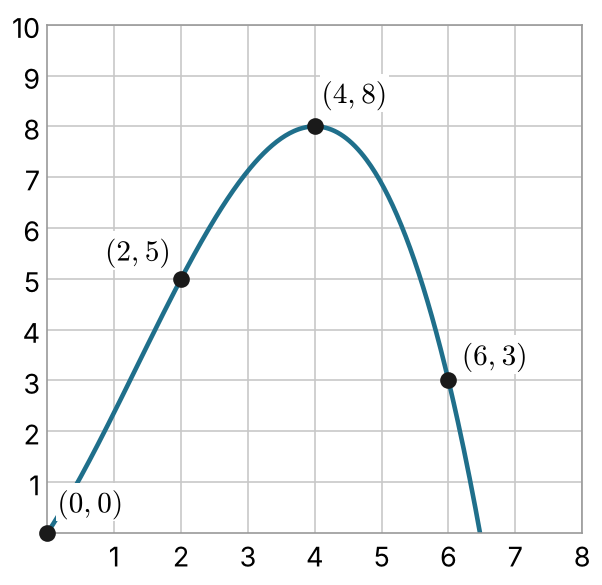
The same graph with the points , , , and marked on the curve.
For our augmented matrix setup, write the polynomial as
Substitute each point:
The first equation gives . The other three equations, with the columns in the order :
Tip: Ordering the columns (instead of ) puts the smallest numbers in the first column, which makes the row reduction easier. With the order , the first column would be 8, 64, 216.
and :
:
and :
, then :
Back substitute. Row 3 gives . Row 2:
Row 1:
Recall .
Answer: